AI Is a Tool. You’re Still the Decision Maker.
This article explores what actually happens to a decision once AI has been asked to help with it.
9 minute read
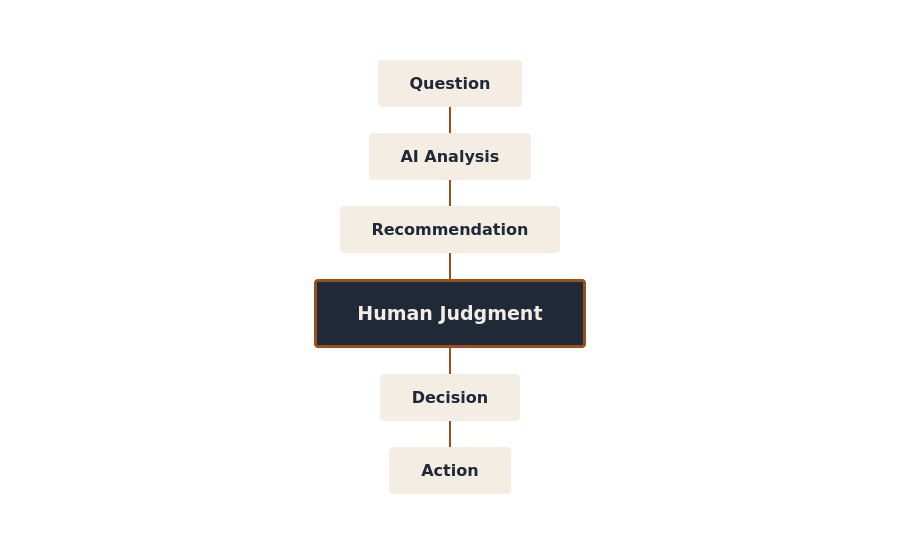
A manager pulls up a recommendation an AI tool generated overnight. It’s clean, confident, and specific: reduce headcount in one department, reallocate the budget to another, revisit the vendor contract in Q3. She reads it once, forwards it to her director with a short note, and moves on to the next meeting.
Nobody in that chain actually owned the decision. A recommendation got passed along a few links further than it should have, each person assuming the person before them had done the thinking. That’s not a hypothetical. It’s the most common way AI actually fails organizations right now, not through some dramatic error, but through a quiet handoff of judgment that nobody consciously agreed to.
The tool didn’t do anything wrong. It did exactly what it was built to do: process available information and produce a plausible answer. The failure, if there is one, belongs entirely to the humans in the chain who treated a plausible answer as a finished decision.
What AI Actually Does, and What It Doesn’t
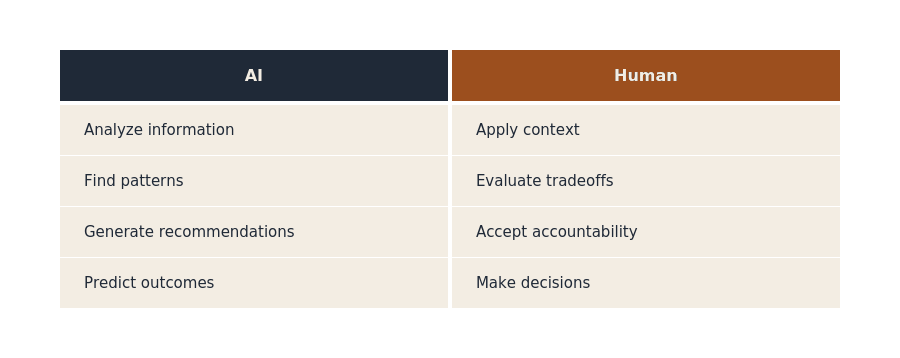
AI is genuinely good at a specific, narrow thing: finding patterns in information faster than a person can, and producing something that sounds like an answer. That’s real, useful capability. It’s also a much smaller thing than it sounds like from the outside.
A decision is not the same as an answer. A decision carries context the tool doesn’t have access to, why a department was already under strain before this quarter, what a client relationship can actually absorb, which recommendation would be technically correct but organizationally impossible to execute right now. A decision also carries accountability. Someone has to own what happens next, explain it if it goes wrong, and adjust if the situation changes. An AI system does none of that, not because it’s flawed, but because that was never what it was for.
Consider two nearly identical requests to the same tool. One person asks it to summarize customer complaints from the last quarter. The other asks it to recommend which product feature to deprioritize based on those complaints. The first request is genuinely well suited to the tool, pattern recognition across a large volume of text is exactly what it’s built for. The second request looks similar on the surface but has quietly asked the tool to make a call it has no basis for making. It doesn’t know which customers are strategically important, which complaints reflect a real product gap versus a support failure, or what the team already tried and abandoned. It will still answer confidently. That confidence is not evidence the answer is right.
The gap between an answer and a decision is exactly where human judgment lives. Skipping that gap doesn’t make a decision faster. It just moves the decision to whoever eventually notices something went wrong, usually much later, and usually at a higher cost than if a person had actually owned the call the first time.
Amplifying Judgment Is Not the Same as Replacing It
There’s a real difference between two people using the same AI tool on the same task, and it has nothing to do with the tool.
One person asks a question, gets an answer, and treats the answer as the conclusion. The other asks a question, gets an answer, and treats it as one input among several: does this match what I already know, what would change if this assumption is wrong, what is this recommendation quietly assuming that might not hold. The first person has outsourced a decision. The second person has used a tool to think faster about a decision they still fully own.
From the outside, both people look equally productive. Both got an answer quickly. Both moved on to the next task. The difference only shows up later, when something the tool didn’t account for turns out to matter. The first person is surprised, because as far as they knew, the question had already been answered. The second person isn’t surprised, because they’d already been carrying a version of that doubt the whole time, quietly checking it against what they knew rather than setting it down the moment an answer arrived.
AI doesn’t remove the need for judgment. It changes where judgment has to show up, earlier, in deciding what to trust, rather than later, in cleaning up what shouldn’t have been trusted.
This is a genuinely different skill than knowing how to use an AI tool well technically. It’s closer to the skill an experienced editor has: not writing every word themselves, but knowing immediately which sentence is quietly wrong even though it reads smoothly. That skill doesn’t come from the tool. It comes from already understanding the problem well enough to recognize when something is off.
Why This Is Easy to Miss
Most poor AI decisions don’t begin with bad intentions. They begin with small moments of convenience.
Nobody sets out to stop deciding. The handoff happens quietly, and it happens for a specific, understandable reason: confidence is persuasive, and AI output is almost always confident, regardless of whether it should be.
A human colleague who isn’t sure will usually say so. They’ll hedge, ask a follow up question, or flag the parts they’re less certain about. An AI system, by default, doesn’t do this. It answers a genuinely uncertain question with the same tone it uses for a well established fact, and that tone is doing more persuasive work than most people realize while they’re reading it. The plausibility of the writing gets quietly mistaken for the reliability of the content.
This isn’t a reason to distrust the tool categorically. It’s a reason to notice that the thing making an answer feel trustworthy, how confident and well organized it sounds, has stopped being a reliable signal of whether it actually is trustworthy. That used to be a decent shortcut with human colleagues, where confidence and competence were at least loosely correlated. It stops working the moment the source of that confidence is a system that sounds equally sure about everything.
The Question This Actually Raises
If judgment is what separates a good outcome from a quietly outsourced one, the obvious next question is uncomfortable: how good is your own judgment on this, right now, today, not in general, but specifically on the kinds of decisions AI is now involved in.
That’s not a question with an obvious answer. Most people have never had a reason to examine it, because until recently, there was no fast, confident-sounding second opinion available for every decision, tempting them to skip the examination. The Four Levels of AI Readiness exist for exactly this reason: not as a scorecard, but as a way of being honest about whether you’re at the stage of accepting answers, or the stage of actually interrogating them before they become decisions.
Most people, most of the time, are somewhere between those two states without having consciously chosen to be. That’s worth noticing before it becomes a habit that’s harder to see from the inside.
Still the Decision Maker
None of this is an argument against using AI. It’s an argument for being honest about what using it well actually requires. A tool that produces fast, confident, plausible answers is genuinely valuable. It’s also exactly the kind of tool that makes it easy to stop noticing when you’ve quietly stopped deciding.
The manager in the opening scene didn’t do anything reckless. She did something ordinary: she trusted a clean, confident answer a little more than it had earned, at exactly the moment a real decision needed her judgment instead. That’s not a story about bad judgment. It’s a story about judgment that never got the chance to show up.
It’s worth imagining the version where it goes differently. Same recommendation, same morning, same meeting. She reads it, and instead of forwarding it, she asks herself the one question the tool couldn’t: does this account for what I already know about why that department is struggling. The answer might still be yes. It might not be. Either way, a decision actually happened in that moment, hers, not the tool’s, and that’s the entire difference.
AI can process information faster than any person. It cannot decide what should happen next, not because it lacks the technical capability, but because that was never its job. The recommendation belonged to the tool. The decision still belongs to you.
Before You Decide
A few questions worth sitting with honestly, not to answer perfectly, just truthfully:
- The last time an AI tool gave you a clean, confident answer, did you check it against what you already knew, or did you accept it because it sounded right?
- Is there a decision moving through your team right now where an AI recommendation is quietly doing more of the deciding than anyone intended?
- What would it actually cost you to add one honest check before passing a recommendation along, and what has it already cost when that check got skipped?
- Which of the Four Levels of AI Readiness actually describes how you used AI this week, not how you’d like to describe it?
Continue Your Thinking
One practical lesson, every week.
Written for people responsible for technology decisions. No hype, no roundups, no sales sequence.