Decision Frameworks Every Technology Leader Should Know
This article explores why having the right decision tool for the moment matters more than knowing every tool that exists.
6 minute read
Marcus took the project in March. The service desk had been running on the same ticketing workflow for eleven years, and leadership wanted it modernized with AI, faster routing, smarter triage, less time spent on requests a machine could handle in seconds. It was a good project. It had budget. It had a clear owner. What it didn’t have, yet, was a single decision made the way Marcus expected to make it.
He assumed the hard part would be technical. It wasn’t. The hard part was that three genuinely different questions would arrive over the life of the project, each one asking to be answered by a different kind of thinking, and Marcus would spend the first one reaching for the wrong tool entirely before he noticed what was actually happening.
The problem was never a lack of knowledge. It was choosing the wrong way to think about the problem.
Having the right framework for the moment matters more than knowing every framework that exists.
Week One: What Actually Needs Attention Right Now
The AI initiative was two weeks old when the support inbox exploded. A vendor outage upstream had knocked out single sign-on for half the company, and the service desk was drowning in tickets it had no automated help for yet, because the automation wasn’t built. Marcus’s instinct was to push through, keep the AI project moving on schedule, treat the outage as a separate fire for someone else to handle.
It was the wrong instinct, and he caught it almost by accident, in a hallway conversation where someone asked him plainly whether the project was actually the most important thing happening that week. It wasn’t. The outage was urgent and important. The AI initiative was important but not urgent, it would still be valuable in a month. Nothing about pausing it lost real ground, and nothing about ignoring the outage to protect a project timeline was defensible if anyone asked why later.
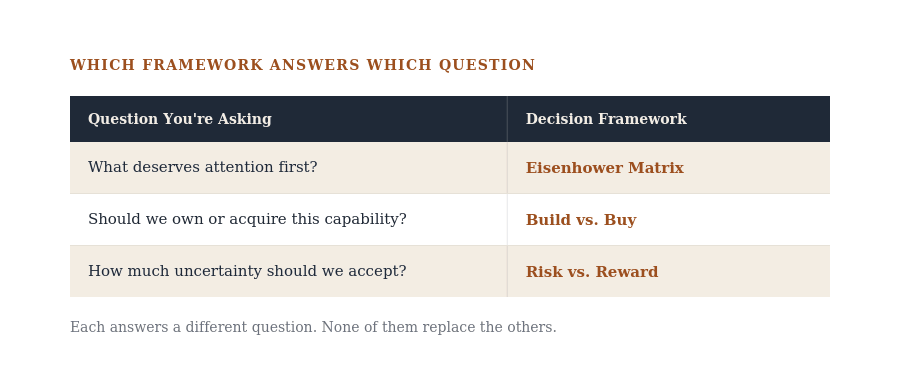
This is what the Eisenhower Matrix actually does. It isn’t a productivity trick. It’s a way of forcing a real answer to a question most people skip past under pressure: is this urgent, is this important, and are you treating those as the same thing when they aren’t. Marcus paused the initiative for eleven days. The outage was resolved. By May, the project was back on track, and the pause had become largely irrelevant.
Use it when competing demands are genuinely pulling in different directions and the instinct to protect momentum is louder than the case for doing so. Don’t use it for decisions that don’t actually have a time-sensitive dimension, it answers what needs attention now, not which of two good long-term options is better. It doesn’t replace the Four Levels either, it doesn’t say anything about how well you use AI once you’ve decided to act, only about whether now is the moment to act at all.
Month Two: Build the Thing, or Buy It
By May, operations had settled and the project resumed with a real question in front of it: build an internal AI assistant tuned to the service desk’s specific ticket history, or buy one of the several existing platforms that already did something close to what leadership wanted. Marcus’s team was capable. That was part of the problem. A capable team can build almost anything, and “we could build this” quietly gets treated as a reason to, even when it isn’t the actual question.
Build vs. Buy exists to separate capability from cost. Not just budget, though that matters, but the slower cost of maintaining something custom for years after the excitement of building it has worn off, versus the real limits of a platform that will never fit the service desk’s workflow quite as precisely as something purpose-built would. Marcus’s team ran the comparison honestly: a purchased platform could be live in six weeks with acceptable, not perfect, fit. A built solution would take four months and fit exactly, but every future change to the ticketing system would need in-house engineering time indefinitely.
They bought the platform. Not because building was wrong in principle, but because the team’s actual capacity for years of maintenance didn’t match the ambition of building something bespoke. Use Build vs. Buy when the real question is long-term ownership, not just which option is more impressive to build. Don’t use it to settle a decision that’s actually about speed or risk alone, those are different questions with different tools, and reaching for this one when the real issue is timeline just dresses up the wrong answer in the right-sounding framework.
Month Four: Everyone at Once, or Somewhere First
The platform was configured by July, tested, ready. Leadership wanted it live company-wide the following Monday. Marcus wanted a pilot first, one department, three weeks, before anything went company-wide. The disagreement wasn’t about whether the tool worked. It was about how much confidence a successful test run actually earns before scaling a decision that would touch every employee’s daily workflow at once.
Risk vs. Reward doesn’t answer whether to proceed. It answers how much of the potential downside you’re actually willing to absorb for a given amount of upside, and whether there’s a way to get most of the reward while limiting most of the exposure. A full launch that goes wrong is expensive and visible in a way a limited pilot’s failure never is. A pilot that goes well doesn’t cost you the company-wide rollout, it just delays it by three weeks and replaces a guess with evidence.
Marcus won the argument, not by being cautious for its own sake, but by naming the actual trade-off out loud: three weeks of delay against the cost of a bad company-wide first impression that would be hard to undo. The pilot ran in one department. It surfaced two real problems nobody had caught in testing. Both got fixed before the wider launch. Use Risk vs. Reward when the size of a mistake matters as much as its likelihood. Don’t use it as a way to avoid ever committing to anything, a framework for evaluating trade-offs isn’t a framework for indefinite delay.
What None of These Frameworks Told Him
Marcus had made three good decisions. Something still felt unresolved.
None of the frameworks told him what to do when a senior leader quietly pushed back on the pilot because it made the timeline he’d already promised his own boss look bad. None of them told him what was fair to the two employees whose workflow the pilot temporarily disrupted while the rest of the company waited. None of them said anything about ethics, pressure, or the parts of leadership that don’t resolve into a clean comparison.
Choosing the right framework for a decision is a real, learnable skill, and most of this article has been about building it. But frameworks only ever answer the question they were built to answer. What happens when the right analytical answer collides with organizational pressure, or when two reasonable people looking at the same trade-off reach different conclusions about what’s fair, that’s not a framework problem anymore. That’s judgment.
Before You Decide
A few questions worth asking about your own next decision, not in the abstract:
- Are you treating something as urgent because it genuinely is, or because momentum makes it feel that way?
- If you’re leaning toward building something in-house, have you honestly costed the years of maintenance, not just the build?
- Is there a way to get most of the reward of a decision while limiting most of the risk, or are you choosing between only two extremes because nobody looked for a third option?
- Which of these three questions is actually in front of you right now, and are you reaching for the framework that answers it, or the one you happen to know best?
Continue Your Thinking
One practical lesson, every week.
Written for people responsible for technology decisions. No hype, no roundups, no sales sequence.