Moving Through the Four Levels
This article explores why knowing your level and actually moving to the next one turn out to be two different skills entirely.
7 minute read
By Thursday, Priya had redesigned her team’s intake process, an automated triage system that routed customer requests straight through an AI classifier with almost no human review. She was proud of it. It felt like progress.
A week later the system was misrouting a meaningful fraction of urgent requests, confidently and consistently, and nobody caught it for four days, because the new process removed the pause where someone used to stop and question the output.
Priya hadn’t skipped a step out of carelessness. Days earlier, she’d read Article 6 and recognized herself honestly: Level 2. She questioned AI output when something felt off, checked a claim here and there, but was still slow to push back hard on an answer that sounded confident. Then she built a Level 3 system anyway, the kind of workflow redesign Article 6 described as leading rather than collaborating, without ever having built the Level 2 habit that Level 3 quietly depends on: actually questioning what the output was telling her.
Knowing Your Level Isn’t the Same as Moving
Article 6 answered a real, necessary question: where do you actually stand, not where you’d like to describe yourself as standing. That answer is a starting point, not a destination. Most people who take that diagnostic honestly and land somewhere they don’t love make the same mistake Priya made. They treat the gap between where they are and where they want to be as a motivation problem, something to close through effort and speed.
It isn’t.
Moving to the next level isn’t about trying harder. It’s about learning a different skill.
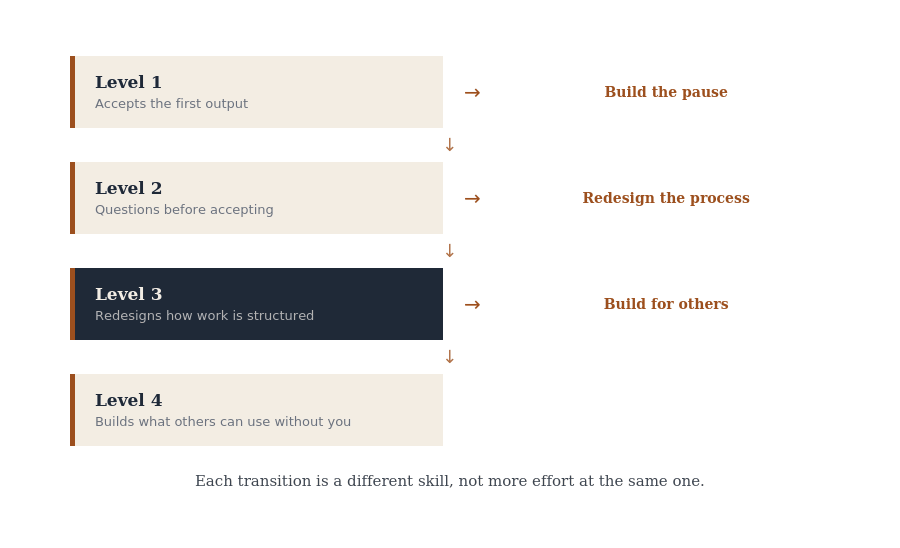
Level 1 to Level 2 is about developing a habit of doubt. Level 2 to Level 3 is about redesigning how work gets structured. Level 3 to Level 4 is about building things other people can use without you. None of those are just “work faster”. Each one asks something genuinely new.
Level 1 to Level 2: Building the Pause
The entire transition from Level 1 to Level 2 lives in a single habit: pausing before you accept an answer, not after something goes wrong. That sounds small. It’s the hardest habit on this list to build precisely because it has to happen before there’s any evidence something needs questioning.
What actually changes is not intelligence or effort, it’s a default. A Level 1 default treats a fluent answer as a finished one. A Level 2 default treats a fluent answer as a first draft of a finished one. Building this default takes repetition in low stakes moments, not a single moment of realization. It shows up as one extra question asked on an ordinary Tuesday, not a dramatic catch during a crisis.
The most common failure at this stage isn’t laziness. It’s that the pause has no visible payoff most of the time, since most AI output is fine, and a habit that rarely gets rewarded is hard to keep. The habit has to survive being unnecessary ninety percent of the time in order to be there for the ten percent that matters.
The biggest leap ahead isn’t learning more about AI. It’s changing how work itself gets designed.
Level 2 to Level 3: The Real Jump
This is the largest transition in the framework, and it’s worth naming that plainly rather than treating all three transitions as equally sized. Level 2 to Level 3 isn’t an extension of the pause habit. It’s a different kind of work entirely: redesigning the process itself, rather than reviewing what the process produces.
A Level 2 person asks better questions about each individual answer. A Level 3 person asks a structural question once, up front: what should this workflow assume about what the tool is good at and what it isn’t, and how should the process be built so that a Level 1 mistake can’t quietly become a Level 4 problem. That’s a design skill, not a review skill, and it’s genuinely uncomfortable the first several times, because it means giving up the safety of catching things one at a time in exchange for getting the structure right before anything runs at all.
Priya’s mistake sits exactly here. She attempted the Level 3 move, redesigning the process, without having actually internalized the Level 2 habit the redesign depended on. A Level 3 system built by someone who has never personally felt the discomfort of a wrong-but-confident answer tends to remove exactly the check that discomfort would have insisted on. The jump from 2 to 3 only holds up if the Level 2 instinct is genuinely there to design around, not just theoretically understood.
This transition also comes with a real, temporary cost that’s worth naming honestly: output usually gets slower before it gets better, because building the right structure takes longer than reviewing outputs one at a time, at least at first. People often abandon the attempt right here, not because the redesign was wrong, but because the dip in visible speed arrives before the payoff does, and nobody warned them it would.
Level 3 to Level 4: Building for Others
The last transition is different in kind from the first two, because it stops being primarily about your own work. A Level 3 person has built a good process for themselves. A Level 4 person has turned that process into something someone else can pick up and use correctly without having personally lived through the mistakes that shaped it.
This requires a specific kind of humility that the earlier transitions don’t ask for: writing down the reasoning behind a design choice clearly enough that someone who disagrees with part of it can actually engage with the reasoning, rather than just inheriting the result.
A prompt review checklist that every analyst on a team runs through before deploying an AI assisted workflow is a small, concrete example of this. The checklist itself isn’t what matters. What matters is that the judgment behind it used to live only in one person’s head, and now it doesn’t. The measure of success at this level isn’t how good your own work is anymore. It’s whether the people around you are visibly better at Level 2 and Level 3 behavior than they would have been without what you built.
You Can’t Skip the Work
Priya’s triage system didn’t fail because she lacked skill. It failed because Level 3 work quietly assumes the Level 2 habit is already there, catching what a redesigned process wasn’t built to catch. Skip the habit, and the redesign doesn’t remove the risk of a wrong answer. It just removes the person who used to notice one.
Every level prepares you for what the next one demands of you. Progress isn’t measured by how quickly you reach Level 4. It’s measured by whether you can still demonstrate the habits that got you there once you’ve moved past needing to think about them consciously. The pause from Level 2 doesn’t disappear at Level 3. It gets built into the structure instead. If it was never really there to begin with, there’s nothing to build in.
Where the Levels Stop Being Enough
Moving up a level changes how you use AI. It doesn’t, by itself, tell you how to make every decision a technology leader actually faces, when to build versus buy, how to weigh urgency against importance, what risk is actually worth taking. The Four Levels describe your relationship to AI specifically. There’s a wider set of decision tools underneath that, tools that matter regardless of what level you’re operating at.
If the Four Levels describe how you work with AI, what helps you decide when one option is actually better than another?
Before You Decide
A few questions worth answering honestly about your own next transition:
- If you’re aiming for Level 3, can you point to a specific, repeated moment where your Level 2 pause actually caught something wrong, or is it still mostly theoretical?
- Have you ever tried to redesign a process before the underlying habit it depends on was actually solid, the way Priya did?
- If you’re already at Level 3, has your work gotten visibly slower before it got better, or did you turn back at the first sign of that dip?
- If you’re aiming for Level 4, is there something you’ve documented well enough that someone who disagrees with part of it could actually engage with your reasoning, not just accept your result?
Continue Your Thinking
One practical lesson, every week.
Written for people responsible for technology decisions. No hype, no roundups, no sales sequence.