Where Does Your Team Actually Stand?
This article explores why three people using the same AI tool on the same task can produce three different qualities of work, and what that actually reveals.
8 minute read
Three people on the same team get the same assignment: read a batch of customer feedback and recommend one action worth taking this week. All three use the same AI tool to help. All three finish in about the same amount of time.
The recommendations are not close to equal. One reads like it was copied straight from the tool’s first answer, plausible, generic, and slightly wrong about which complaint actually mattered most. Another is sharper, the person clearly pushed back on the initial output and asked a follow-up question before settling on an answer. The third is different again, that person restructured the whole exercise, building a lightweight process the tool could plug into rather than just answering the prompt once and moving on.
Their team lead assumes this is about experience. Two of the three have been at the company about the same length of time. It isn’t experience. It’s not even skill with the tool, exactly. It’s that the three of them are operating at three different levels of AI readiness, and nobody, including them, has ever named it out loud.
The Tool Was Never the Variable
This is the part worth sitting with before going further. All three people had access to the identical tool. None of them used a better model, a smarter prompt template, or some hidden feature the others lacked. The tool was constant across all three outcomes.
What varied was what each person did with what the tool gave them. One accepted it. One questioned it. One redesigned around it. That’s not a skill gap in the traditional sense, it’s the same distinction Article 4 already named: the Four Levels of AI Readiness. Level 1 uses AI. Level 2 collaborates with it. Level 3 leads with it, reshaping how the work gets done rather than just doing the same work slightly faster.
Most conversations about AI performance skip this distinction entirely. They ask whether someone is “good with AI” as if it were one skill, measured on one scale. It isn’t. It’s a level, and knowing which one you’re actually at, not which one you’d like to claim, is the whole point of this article.
What Each Level Actually Looks Like
Not as a definition to memorize. As a mirror. The point of this section is to recognize yourself, not just read past four labeled paragraphs.
Level 1 looks like accepting the first output. Not rereading closely before sending it along. Treating a fluent, well-organized answer as a correct one, because it sounds correct, and sounding correct is easy to mistake for being correct.
Level 2 looks like a pause before acceptance. Asking one more question when something feels slightly off, even without being able to say exactly why. Checking at least one specific claim before repeating it to someone else. Still, often, slow to push back hard on an answer that sounds confident, even when confidence and accuracy have quietly stopped being the same thing.
Level 3 looks like redesign, not just review. Someone at this level isn’t only checking the tool’s output, they’re rethinking how the task gets structured so the tool’s strengths and limits are both accounted for from the start. They also tend to become the person others quietly route questions to, without that ever becoming an official part of their job.
Level 4 looks like building the scaffolding that makes it easier for everyone else to operate at Level 2 or 3 without having to discover it the hard way, templates, checks, shared habits that outlive any one person’s individual skill.
A Team Is Rarely at One Level
Here is the more useful, and more uncomfortable, observation. Teams don’t sit uniformly at a single level. The normal case is a mix, and that mix is usually invisible until something makes it visible, like three people getting the same assignment on the same day.
What a mixed-level team actually looks like day to day: inconsistent quality on tasks that appear identical from the outside. One person’s work quietly needing more review than another’s, for reasons nobody has ever named directly. A Level 3 person doing informal quality control that was never assigned to them, simply because they’re the one who notices when something’s off.
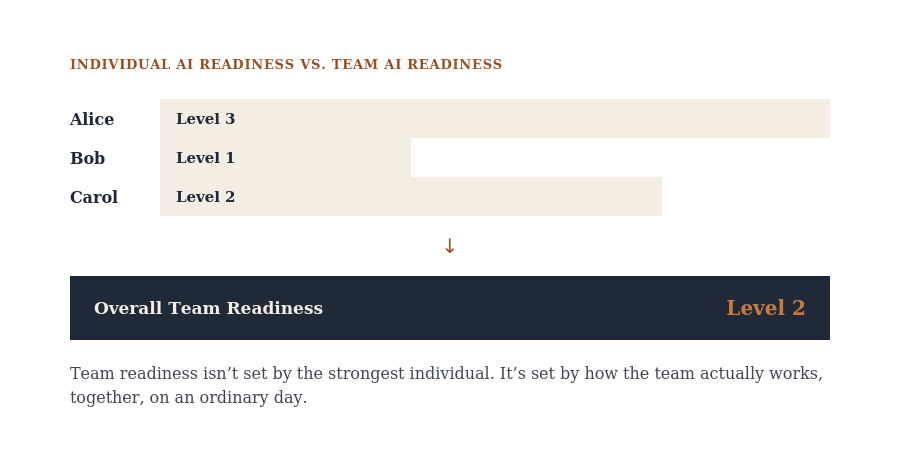
This is worth stating plainly, because it cuts against how most people think about their own readiness. Someone can genuinely operate at Level 3 individually, and still work inside a team whose actual day-to-day environment functions closer to Level 1, because the team’s habits, incentives, and shared expectations were never brought up to match the most capable person on it. Individual readiness and team readiness are not the same measurement. Assuming they are is itself part of the problem this article is naming.
What Actually Gets in the Way
Diagnosing this honestly means naming what stops a team from moving up a level, even when individuals on it genuinely want to. Three real barriers show up consistently.
The first is language. Without a shared way to name the levels, a team has no way to talk about the gap at all, only vague, half-formed complaints about inconsistent quality that never quite turn into a real conversation. A manager who notices one person’s work needing more review than another’s usually has no vocabulary more precise than “double-check that one a bit more,” which sounds like a judgment about the person rather than a description of where they currently sit. Naming the level instead of the person changes what the conversation can actually be about.
The second is incentive. When speed is what gets noticed and rewarded, Level 1 behavior looks identical to Level 2 behavior on the surface, both get the task done on time. The extra beat Level 2 takes to question an answer doesn’t show up anywhere unless someone is actually looking for it, and in most day to day work, nobody is. A team can genuinely value careful, questioning use of AI in principle while its actual weekly rhythm rewards whoever turns things around fastest, and the gap between the stated value and the rewarded behavior is where Level 2 habits quietly erode back toward Level 1.
The third is visibility. A team with nobody modeling Level 3 behavior out loud has no natural way to learn it. It has to be demonstrated, not just described, and demonstration requires someone doing it where others can actually see the difference it makes, not just producing a better result with no visible trace of how they got there. A Level 3 person working quietly and a Level 1 person working quietly look the same from across the room. The only difference anyone can learn from is the one they’re shown.
None of these are solved by this article. They’re solved by leadership decisions this piece isn’t making, on purpose. Diagnosing the gap accurately comes first. What a team does about it comes later.
Before You Ask How to Move Up
The three people in the opening scene didn’t fail an assignment. They revealed something that was already true before the assignment existed, three different relationships with the same tool, never named, never discussed, quietly producing three different outcomes on work that looked identical on paper.
The instinct, once you notice this, is to immediately ask how to fix it, how to move a Level 1 habit toward Level 2, how to get a team’s floor closer to its ceiling. That’s a real, important question. It’s not this article’s question.
This article’s job was narrower and, in a way, harder: an honest, unflattering look at where you and your team actually stand right now, not where you’d like to describe yourselves as standing. That answer has to come first. Everything about moving forward depends on getting it right.
Your team’s AI readiness isn’t measured by its most advanced person. It’s measured by what actually happens on an ordinary Tuesday, across everyone doing the work.
Before You Decide
A few questions worth answering honestly about yourself and your team, not in the abstract:
- If three people on your team did the same task with AI today, would you expect three noticeably different outcomes, and could you say why?
- Which of the four levels actually describes your own habits this week, not the level you’d choose if asked in a meeting?
- Is there someone on your team quietly doing informal quality control on AI-assisted work that was never assigned to them?
- Does your team have any shared language for talking about this at all, or does it stay an unnamed, ambient sense that some people’s output needs more checking than others’?
Continue Your Thinking
One practical lesson, every week.
Written for people responsible for technology decisions. No hype, no roundups, no sales sequence.